The Ruby Grading Quality: Ensuring Consistency and Quality for Large-Scale Jewelry Production
Last updated: 3 Apr 2026
164 Views
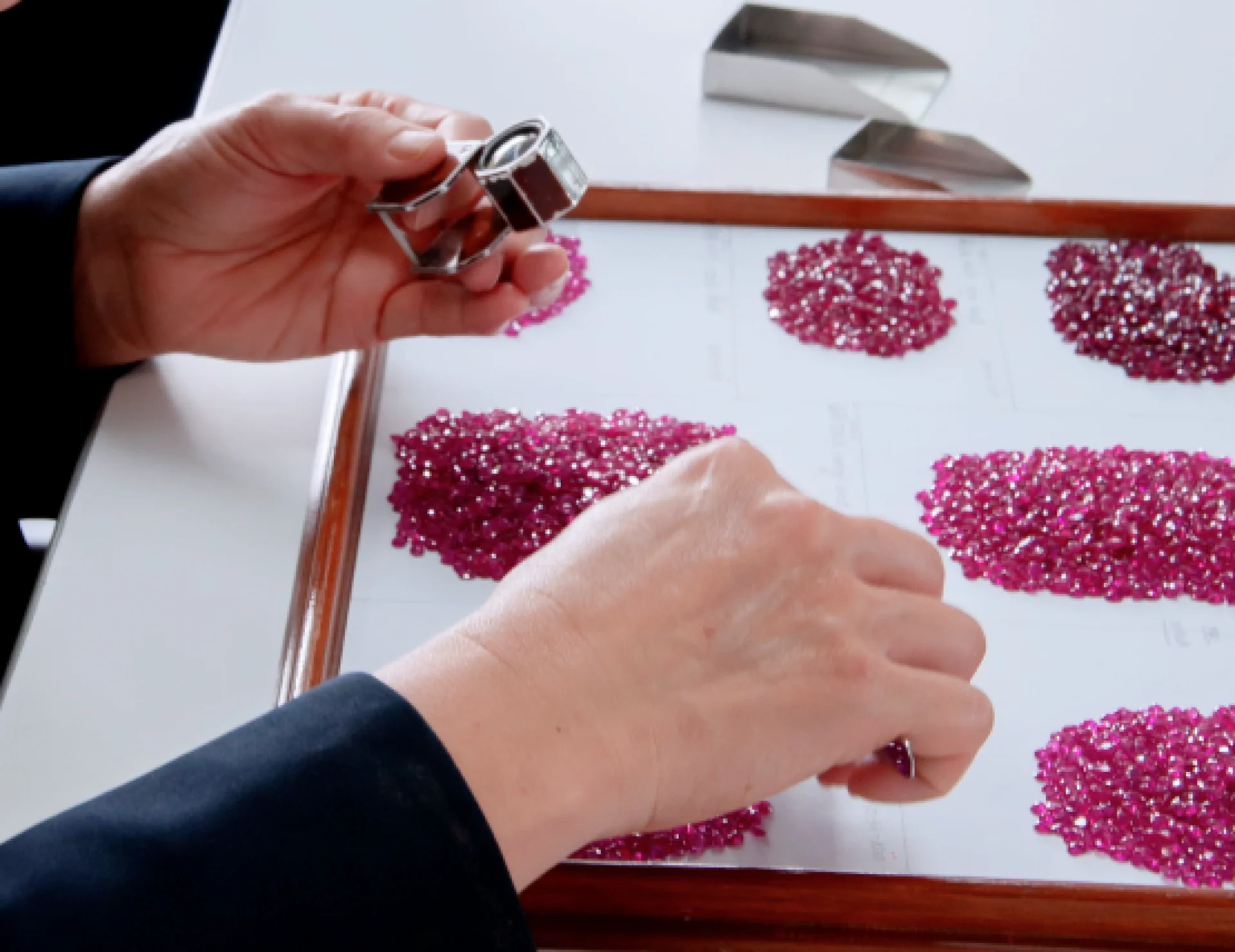
The Ruby Grading Quality: Ensuring Consistency and Quality for Large-Scale Jewelry Production
When it comes to creating high-quality jewelry at scale, the consistency is everything. Ruby, one of the most prized and visually striking gemstones, can vary significantly in color, clarity, and structure. Without a proper grading system, producing uniform jewelry pieces becomes nearly impossible.
For manufacturers, wholesalers, or brands working with large-volume orders, understanding the ruby grading is the key to achieving both beauty and reliability in every finished piece.
Therefore, this article is a guide that dives into what Ruby truly is, how professional grading works, and why Ruby grading is crucial for consistent, high-quality jewelry production, especially for businesses handling large-scale manufacturing
What Is Ruby?
Ruby is a red variety of the mineral corundum, composed primarily of aluminum oxide. Its rich red color comes from trace amounts of chromium, resulting in shades ranging from pinkish-red to a deep, vivid as pigeon-blood red shade. Rubies are famous for their durability and also rank 9 on the Mohs scale, making them ideal for fine jewelry settings that require long-lasting wear.
Ruby Grading Criteria Used in the Industry
Ruby grading is considered an art and a science. It requires combining visual expertise with standardized gemological techniques to categorize each stone with precision. For manufacturers handling thousands of rubies at a time, understanding these grading methods is crucial for ensuring consistent quality.
Below are the 7 industry-standard grading criteria of Ruby
1. Color Grading: The Most Influential Value Factor
Color grading is the most influential factor in determining a ruby’s value, and it becomes even more critical in large-scale jewelry production where consistency is essential.
Professional graders evaluate color through hue, tone, and saturation, the three elements that define the richness and quality of a ruby’s appearance. The most desirable hue ranges from pure red to slightly purplish red, while stones with brownish, orange, or pinkish secondary tones are considered less ideal, especially when matching stones side by side.
Tone reflects how light or dark the ruby appears, with medium to medium-dark tones preferred because overly dark stones look dull and overly light ones resemble pink sapphires.
Lastly, the saturation measures the intensity of color, and strong to vivid saturation creates the iconic deep red associated with high-quality rubies. For mass production, even tiny differences in these color attributes can disrupt visual uniformity, which is why factories perform detailed color grouping, micro-sorting, and matching for pairs and multi-stone pieces.
This level of precision ensures that every stone in a design line, from earrings to bracelets, maintains the same color harmony, making color matching one of the most demanding yet essential processes in producing premium ruby jewelry at scale.
2. Clarity Assessment: Understanding Ruby’s Natural Inclusions
Clarity grading is also the second most essential part of evaluating rubies, especially for large-scale jewelry production, where uniformity and durability matter. Because rubies naturally form with inclusions, graders focus not on eliminating them but on understanding how they affect a stone’s beauty, transparency, and structural stability.
Common inclusions such as rutile needles, crystal particles, color zoning, fingerprint-like patterns, and surface-reaching feathers are all assessed to determine how visible and impactful they are. Clarity is typically categorized from rare eye-clean stones, to slightly included rubies with minimal visible inclusions, to moderately included commercial-grade stones, and finally, highly included pieces that may appear cloudy or structurally weaker.
For manufacturers, consistent clarity grading is crucial because it influences brilliance, durability during stone-setting, and overall perceived quality. Ensuring that each ruby within a collection shares similar clarity characteristics allows production teams to maintain a uniform look and feel, ultimately enhancing customer satisfaction and brand reliability across all jewelry lines.
3. Cut, Shape, and Proportion Analysis
A well-executed cut enhances color, brilliance, and overall symmetry, ensuring the ruby appears lively rather than dull or uneven. Moreover, symmetry-custingis is essential because balanced facets help light reflect evenly across the surface, creating a uniform sparkle that customers expect in high-quality jewelry.
Proportions also matter greatly; stones cut too deep become overly dark and lose brightness, while stones cut too shallow develop a “windowed” appearance where light passes straight through without reflecting. Polish further influences appearance, as smoother facets produce sharper light return and a more luminous finish.
Finally, shape consistency is absolutely vital for calibrated jewelry settings—each ruby must match precise millimeter measurements, facet alignment, and table height so manufacturers can set them efficiently across rings, earrings, pendants, and bracelets without re-adjusting molds or metalwork.
4. Treatment Detection and Certification
Treatment detection plays a vital role in ruby grading because enhancements significantly influence a stone’s value, durability, and suitability for large-scale jewelry production. While heat treatment is widely accepted as an industry standard for improving color and clarity, other treatments, such as lead-glass filling, diffusion, and oil or resin infusions, require careful identification as they can weaken the stone or artificially enhance its appearance.
For manufacturers, knowing exactly which treatments a ruby has undergone ensures transparency, helps avoid quality discrepancies, and prevents the accidental mixing of high-end and lower-grade stones within the same production line.
5. Size, Weight, and Calibration Accuracy
Calibration accuracy is one of the most crucial factors in large-scale jewelry production, as rubies must be cut to precise millimeter measurements to fit seamlessly into pre-designed molds and settings. Calibrated stones follow strict size tolerances, which are often within ±0.1 mm or even tighter for premium lines, to ensure consistent fitting across rings, earrings, pendants, bracelets, and so on.
This level of precision eliminates the need for additional metal adjustments, reduces production time, and ensures aesthetic uniformity across entire collections. Accurate calibration also enables manufacturers to create perfectly matched pairs and multi-stone pieces, maintaining a consistent look and improving efficiency throughout the assembly and finished-product stages
6. Origin Determination (Advanced Grading Factor)
Origin determination is an advanced aspect of ruby grading, as the geographic source of a ruby can greatly affect its value, market positioning, and color expectations. For example, Rubies from Myanmar are known for their highly prized pigeon-blood red hue, while stones from Mozambique, Thailand, Sri Lanka, and Vietnam each carry unique characteristics and color profiles.
To determine origin, gemologists analyze inclusion patterns, ultraviolet-visible spectroscopy, and trace-element composition, enabling accurate classification based on region-specific traits.
7. Fluorescence & Light Performance
Fluorescence and light performance are important grading factors because they influence how a ruby appears under different lighting conditions, which directly impacts the final appeal of jewelry pieces. Many rubies fluoresce under UV light due to chromium content, enhancing the perceived richness of their red color, especially in natural daylight.
For large-scale production, understanding a stone’s fluorescence helps ensure that rubies selected for the same design exhibit consistent visual behavior in real-world environments.
How Premier-BKK Supports High-Volume Ruby Production
At Premier-BKK, our expertise lies not only in sourcing high-quality gemstones but also in ensuring precision grading suitable for large-scale jewelry manufacturing. Our team provides:
● Calibrated rubies in multiple sizes
● Consistent lot-by-lot grading
● Professional certification and transparency
● Bulk sourcing with strict quality checks
● Customized grading tailored to your production requirements
We help jewelry brands create product lines that shine with consistency, beauty, and lasting quality every single time.
Therefore, the art of ruby grading is more than evaluating a gemstone—it is an essential process that ensures consistency, quality, and reliability for large-scale jewelry production. For manufacturers, wholesalers, and global jewelry brands, proper grading standards ensure that every jewelry piece looks uniform, fits perfectly, and meets customer expectations.
With Premier-BKK’s expertise in high-quality gemstones and professional grading, your brand can achieve flawless results from concept to finished product—every collection, every batch, every time.
When it comes to creating high-quality jewelry at scale, the consistency is everything. Ruby, one of the most prized and visually striking gemstones, can vary significantly in color, clarity, and structure. Without a proper grading system, producing uniform jewelry pieces becomes nearly impossible.
For manufacturers, wholesalers, or brands working with large-volume orders, understanding the ruby grading is the key to achieving both beauty and reliability in every finished piece.
Therefore, this article is a guide that dives into what Ruby truly is, how professional grading works, and why Ruby grading is crucial for consistent, high-quality jewelry production, especially for businesses handling large-scale manufacturing
What Is Ruby?
Ruby is a red variety of the mineral corundum, composed primarily of aluminum oxide. Its rich red color comes from trace amounts of chromium, resulting in shades ranging from pinkish-red to a deep, vivid as pigeon-blood red shade. Rubies are famous for their durability and also rank 9 on the Mohs scale, making them ideal for fine jewelry settings that require long-lasting wear.
Ruby Grading Criteria Used in the Industry
Ruby grading is considered an art and a science. It requires combining visual expertise with standardized gemological techniques to categorize each stone with precision. For manufacturers handling thousands of rubies at a time, understanding these grading methods is crucial for ensuring consistent quality.
Below are the 7 industry-standard grading criteria of Ruby
1. Color Grading: The Most Influential Value Factor
Color grading is the most influential factor in determining a ruby’s value, and it becomes even more critical in large-scale jewelry production where consistency is essential.
Professional graders evaluate color through hue, tone, and saturation, the three elements that define the richness and quality of a ruby’s appearance. The most desirable hue ranges from pure red to slightly purplish red, while stones with brownish, orange, or pinkish secondary tones are considered less ideal, especially when matching stones side by side.
Tone reflects how light or dark the ruby appears, with medium to medium-dark tones preferred because overly dark stones look dull and overly light ones resemble pink sapphires.
Lastly, the saturation measures the intensity of color, and strong to vivid saturation creates the iconic deep red associated with high-quality rubies. For mass production, even tiny differences in these color attributes can disrupt visual uniformity, which is why factories perform detailed color grouping, micro-sorting, and matching for pairs and multi-stone pieces.
This level of precision ensures that every stone in a design line, from earrings to bracelets, maintains the same color harmony, making color matching one of the most demanding yet essential processes in producing premium ruby jewelry at scale.
2. Clarity Assessment: Understanding Ruby’s Natural Inclusions
Clarity grading is also the second most essential part of evaluating rubies, especially for large-scale jewelry production, where uniformity and durability matter. Because rubies naturally form with inclusions, graders focus not on eliminating them but on understanding how they affect a stone’s beauty, transparency, and structural stability.
Common inclusions such as rutile needles, crystal particles, color zoning, fingerprint-like patterns, and surface-reaching feathers are all assessed to determine how visible and impactful they are. Clarity is typically categorized from rare eye-clean stones, to slightly included rubies with minimal visible inclusions, to moderately included commercial-grade stones, and finally, highly included pieces that may appear cloudy or structurally weaker.
For manufacturers, consistent clarity grading is crucial because it influences brilliance, durability during stone-setting, and overall perceived quality. Ensuring that each ruby within a collection shares similar clarity characteristics allows production teams to maintain a uniform look and feel, ultimately enhancing customer satisfaction and brand reliability across all jewelry lines.
3. Cut, Shape, and Proportion Analysis
A well-executed cut enhances color, brilliance, and overall symmetry, ensuring the ruby appears lively rather than dull or uneven. Moreover, symmetry-custingis is essential because balanced facets help light reflect evenly across the surface, creating a uniform sparkle that customers expect in high-quality jewelry.
Proportions also matter greatly; stones cut too deep become overly dark and lose brightness, while stones cut too shallow develop a “windowed” appearance where light passes straight through without reflecting. Polish further influences appearance, as smoother facets produce sharper light return and a more luminous finish.
Finally, shape consistency is absolutely vital for calibrated jewelry settings—each ruby must match precise millimeter measurements, facet alignment, and table height so manufacturers can set them efficiently across rings, earrings, pendants, and bracelets without re-adjusting molds or metalwork.
4. Treatment Detection and Certification
Treatment detection plays a vital role in ruby grading because enhancements significantly influence a stone’s value, durability, and suitability for large-scale jewelry production. While heat treatment is widely accepted as an industry standard for improving color and clarity, other treatments, such as lead-glass filling, diffusion, and oil or resin infusions, require careful identification as they can weaken the stone or artificially enhance its appearance.
For manufacturers, knowing exactly which treatments a ruby has undergone ensures transparency, helps avoid quality discrepancies, and prevents the accidental mixing of high-end and lower-grade stones within the same production line.
5. Size, Weight, and Calibration Accuracy
Calibration accuracy is one of the most crucial factors in large-scale jewelry production, as rubies must be cut to precise millimeter measurements to fit seamlessly into pre-designed molds and settings. Calibrated stones follow strict size tolerances, which are often within ±0.1 mm or even tighter for premium lines, to ensure consistent fitting across rings, earrings, pendants, bracelets, and so on.
This level of precision eliminates the need for additional metal adjustments, reduces production time, and ensures aesthetic uniformity across entire collections. Accurate calibration also enables manufacturers to create perfectly matched pairs and multi-stone pieces, maintaining a consistent look and improving efficiency throughout the assembly and finished-product stages
6. Origin Determination (Advanced Grading Factor)
Origin determination is an advanced aspect of ruby grading, as the geographic source of a ruby can greatly affect its value, market positioning, and color expectations. For example, Rubies from Myanmar are known for their highly prized pigeon-blood red hue, while stones from Mozambique, Thailand, Sri Lanka, and Vietnam each carry unique characteristics and color profiles.
To determine origin, gemologists analyze inclusion patterns, ultraviolet-visible spectroscopy, and trace-element composition, enabling accurate classification based on region-specific traits.
7. Fluorescence & Light Performance
Fluorescence and light performance are important grading factors because they influence how a ruby appears under different lighting conditions, which directly impacts the final appeal of jewelry pieces. Many rubies fluoresce under UV light due to chromium content, enhancing the perceived richness of their red color, especially in natural daylight.
For large-scale production, understanding a stone’s fluorescence helps ensure that rubies selected for the same design exhibit consistent visual behavior in real-world environments.
How Premier-BKK Supports High-Volume Ruby Production
At Premier-BKK, our expertise lies not only in sourcing high-quality gemstones but also in ensuring precision grading suitable for large-scale jewelry manufacturing. Our team provides:
● Calibrated rubies in multiple sizes
● Consistent lot-by-lot grading
● Professional certification and transparency
● Bulk sourcing with strict quality checks
● Customized grading tailored to your production requirements
We help jewelry brands create product lines that shine with consistency, beauty, and lasting quality every single time.
Therefore, the art of ruby grading is more than evaluating a gemstone—it is an essential process that ensures consistency, quality, and reliability for large-scale jewelry production. For manufacturers, wholesalers, and global jewelry brands, proper grading standards ensure that every jewelry piece looks uniform, fits perfectly, and meets customer expectations.
With Premier-BKK’s expertise in high-quality gemstones and professional grading, your brand can achieve flawless results from concept to finished product—every collection, every batch, every time.
Related Content
When we talk about Calibrated Gemstones In the world of modern jewellery manufacturing, there are factors that are as essential as the consistency of gemstones. Whether producing high-end fine jewelry or large-scale commercial collections, calibrated gemstones ensure that every piece is beautiful, structurally sound, and economically efficient.
24 Mar 2026
Sapphire is one of the most treasured gemstones in fine jewelry, admired for its outstanding durability, radiant brilliance, and remarkable range of colors. As a member of the corundum mineral family, sapphire ranks 9 on the Mohs hardness scale, making it second only to diamond and exceptionally suitable for everyday wear.
20 Mar 2026

8–12 September 2026
Queen Sirikit National Convention Center (QSNCC), Bangkok
LG Foyer | Booths FB, FC 47–51
Premier Gems is delighted to announce our participation in the 74th Bangkok Gems & Jewelry Fair 2026, one of Asia's leading international trade exhibitions for the gemstone and jewellery industry.
15 Jul 2026
